What This Audit Can — and Cannot — Claim
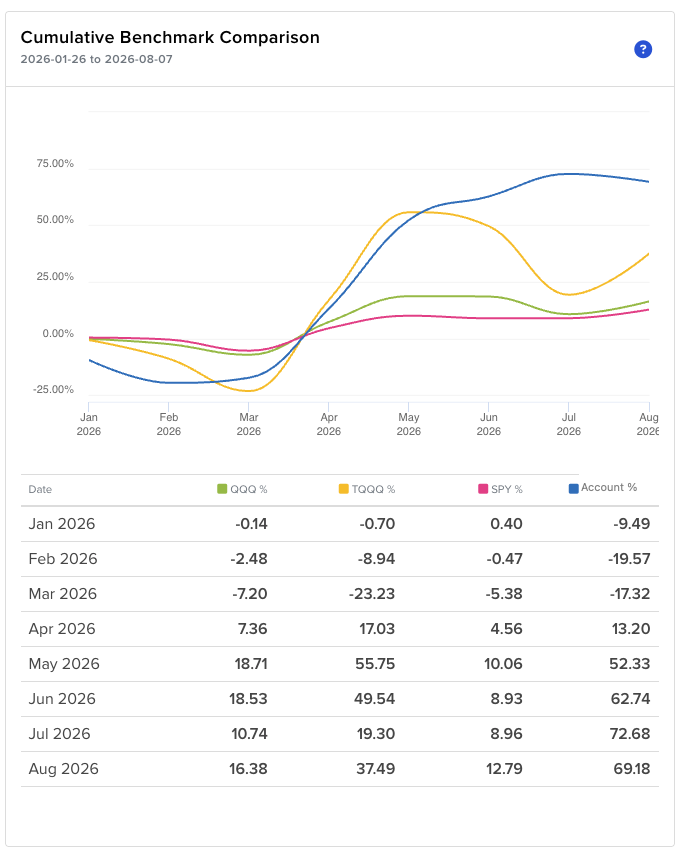
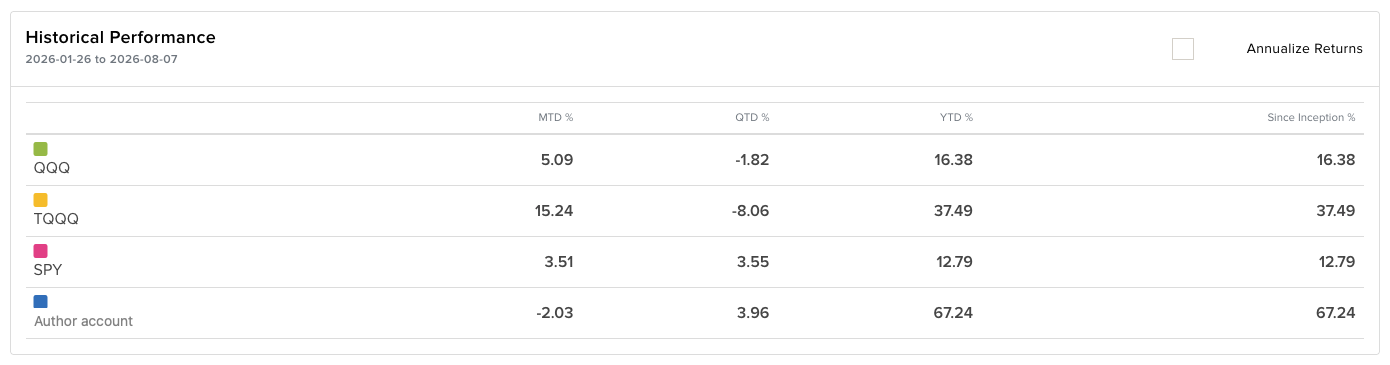
The account opened on January 26. By August 7, the broker's historical summary showed +67.24% since inception. Over the same displayed period, QQQ showed +16.38%, TQQQ +37.49%, and SPY +12.79%.
That is an encouraging account result, but it is not a pure Helios result. Helios was the primary research and decision-support system used to organize evidence and narrow attention. The author still decided which records to ignore, what deserved capital, how much risk to use, and when to close a position.
There is no complete transaction-level attribution ledger connecting every Helios observation to every author decision. The honest claim is therefore narrower: the account result is real and Helios materially influenced the research process, but the share of the result attributable to the system has not been established.
Helios was also only about two months old during this sample. It was collecting T+3 and T+7 outcomes, finding filter leakage, and calibrating against cohorts that were just beginning to mature. Higher accuracy remains a research objective, not a promise.
Audit boundary
- Closed historical window through August 7, 2026
- Account identifier, balances, holdings, orders, and current exposure excluded
- Broker figures are unaudited and have not been independently verified
- No mechanical attribution of the account result to Helios
The Curve and the Unreconciled Denominator
The ending number hides a difficult path. The account was down 9.49% by the end of January, down 19.57% in February, and still down 17.32% in March. It crossed into positive territory in April, accelerated in May and June, reached +72.68% in July, and then pulled back in August.
The broker's two views do not report the same ending number. The cumulative comparison shows +69.18%, while the historical-performance summary shows +67.24% for the same displayed window. The calculation difference has not been reconciled, so this article uses the lower figure and retains both screenshots.
These are raw account and benchmark outcomes, not a risk-adjusted comparison. Different leverage, concentration, turnover, and instrument choices can produce very different paths. The images document what happened to this account; they do not establish repeatability or representativeness.
The Fast Attention Route Had a Denominator
Helios's faster route is an attention filter: it marks records that deserve a closer research look. Because many records carried narrative conditions rather than a uniform pair of numeric boundaries, this audit measures directional follow-through at T+3 and T+7 instead of claiming target precision.
From June 1 through July 29, 85 matured public run-symbol records were eligible for the audit. Twenty-two were positive at both T+3 and T+7, 37 were negative at both checkpoints, and 26 were mixed. The clean positive-both rate was 25.9%.
The positive records are real, but so is the denominator. The route surfaced several large moves while also sending a substantial amount of material to the operator for further filtering.
| Record | Public date | T+3 | T+7 |
|---|---|---|---|
| SNDK | July 29 | +26.79% | +20.52% |
| NOW | July 23 | +20.32% | +24.20% |
| AMD | July 29 | +12.82% | +11.56% |
| PLTR | June 26 | +10.75% | +15.83% |
| INTC | June 17 | +9.23% | +8.77% |
Historical outcome audit
Two denominators, not just the highlights
Fast attention route
June 1-July 29 matured cohort
85
Opportunity route
July 15-29 strict cohort
22
Opportunity Records: Five Upper-Boundary First, Eight Failure-First
The slower Opportunity route retained immutable outbound snapshots beginning July 15. Its first strict mature cohort contained 22 independent public tracks from July 15 through July 29.
Five reached the upper reference boundary before the failure boundary. Eight crossed the failure boundary first. Four reached neither boundary within seven completed sessions, and five were stale or internally inconsistent at the same-day close and were excluded from scoring.
Among the 17 eligible records, the upper-boundary-first rate was 29.4%. Only four of those paths stayed clean through T+7. FICO reached its upper boundary on session one, then crossed the failure boundary on session three and finished T+7 down 14.76%; classifying that path as a clean success would erase the information that mattered.
The failures were equally important. MRNA crossed its failure boundary the next session and closed T+7 down 20.47%. The bearish GOOGL record moved 10.98% against the observation by T+7, while CALM crossed its failure boundary on session four and closed T+7 down 9.01%.
| Record | Reference close | Upper boundary | Failure boundary | T+7 | Audit verdict |
|---|---|---|---|---|---|
| NSIT | $114.19 | $125.00 | $100.62 | +11.97% | upper boundary on session 6; clean through T+7 |
| LQDA | $84.42 | $85.42 | $76.79 | +5.57% | upper boundary on session 1; clean through T+7 |
| OSCR | $28.34 | $30.26 | $27.02 | +6.25% | upper boundary on session 1; clean through T+7 |
| SN | $159.22 | $171.07 | $154.51 | +16.52% | upper boundary on session 5; clean through T+7 |
| FICO | $1,280.57 | $1,335.61 | $1,214.44 | -14.76% | upper boundary first, then failure boundary |
What Helios Can Honestly Take Credit For
Helios clearly influenced the process. It organized market evidence, compressed the attention surface, preserved historical conditions, and made it harder to rewrite a thesis after the outcome was known. Several public records captured substantial follow-through, and the failure boundaries helped expose deteriorating ideas.
The account result still combines system output with operator selection, timing, sizing, and discretion. The operator skipped records, used different risk budgets, and could close positions before or after a system checkpoint. Without a verified observation-to-decision ledger, system edge and operator effect cannot be separated with confidence.
That is why the account curve, the full fast-route denominator, and the Opportunity path audit belong on the same page. Removing any one of them would make the story cleaner and the research weaker.
What Changes in the Next Research Cycle
Three records now need to mature side by side: the complete fast-route cohort, including quiet and negative rows; the Opportunity path, including stale records and reversals; and the account result, with enough attribution to show which observations actually affected a decision.
That ledger changes the question from 'did the account go up?' to 'what did Helios surface, what did the operator choose, what failed, and where did the result actually come from?'
The account curve is encouraging. The fast route remains noisy. The Opportunity route contains several clean records and more failures than wins in its first strict cohort. Helios remains early in calibration. All four statements can be true at the same time.
Source and Publication Note
This Free edition adapts the Perchery article published on Substack on August 9, 2026. The original Perchery content ID and public distribution URLs are preserved in the shared editorial record.
The broker screenshots are the same public redacted assets used in the source edition. Quant replaces the source edition's outbound-message screenshots with a neutral cohort chart so private originals and operational fields remain outside the website repository.