Bad News Lost Its Pricing Power
The market is not ignoring bad news. Bad news has simply lost most of its pricing power.
July retail sales fell 0.6%. Consumer sentiment softened. Brent crude climbed back toward $89 while the Iran and Hormuz mess remained unresolved. Long-term Treasury yields are sitting at levels that would normally make expensive growth stocks sweat.
The broad market barely flinched.
Technology and semiconductors did soften on Friday. SOXX fell about 1%, yet pockets of the highest-beta AI trade remained aggressively bid. The S&P 500 remained close to its record.
That is not a market with no bad news. It is a market where the marginal buyer currently has better things to do than care about it.
Even the political soundtrack fits. Donald Trump said in July that the market was going to "go through the roof." Near all-time highs, with AI stocks ripping and volatility still subdued, that sounds less like a forecast and more like the prevailing dress code.
I am not fighting the tape just because it looks ridiculous. Ridiculous can keep running. I do think the macro explanation for this run has become much thinner than the price action suggests.
The Rally Is Celebrating the Absence of Pain
The clean story is that softer labor data, a tolerable CPI report and a softer PPI report have reduced the odds of another Federal Reserve hike. After the latest data, rate markets moved toward something close to a two-thirds chance of a September hold and roughly one-third odds of a hike.
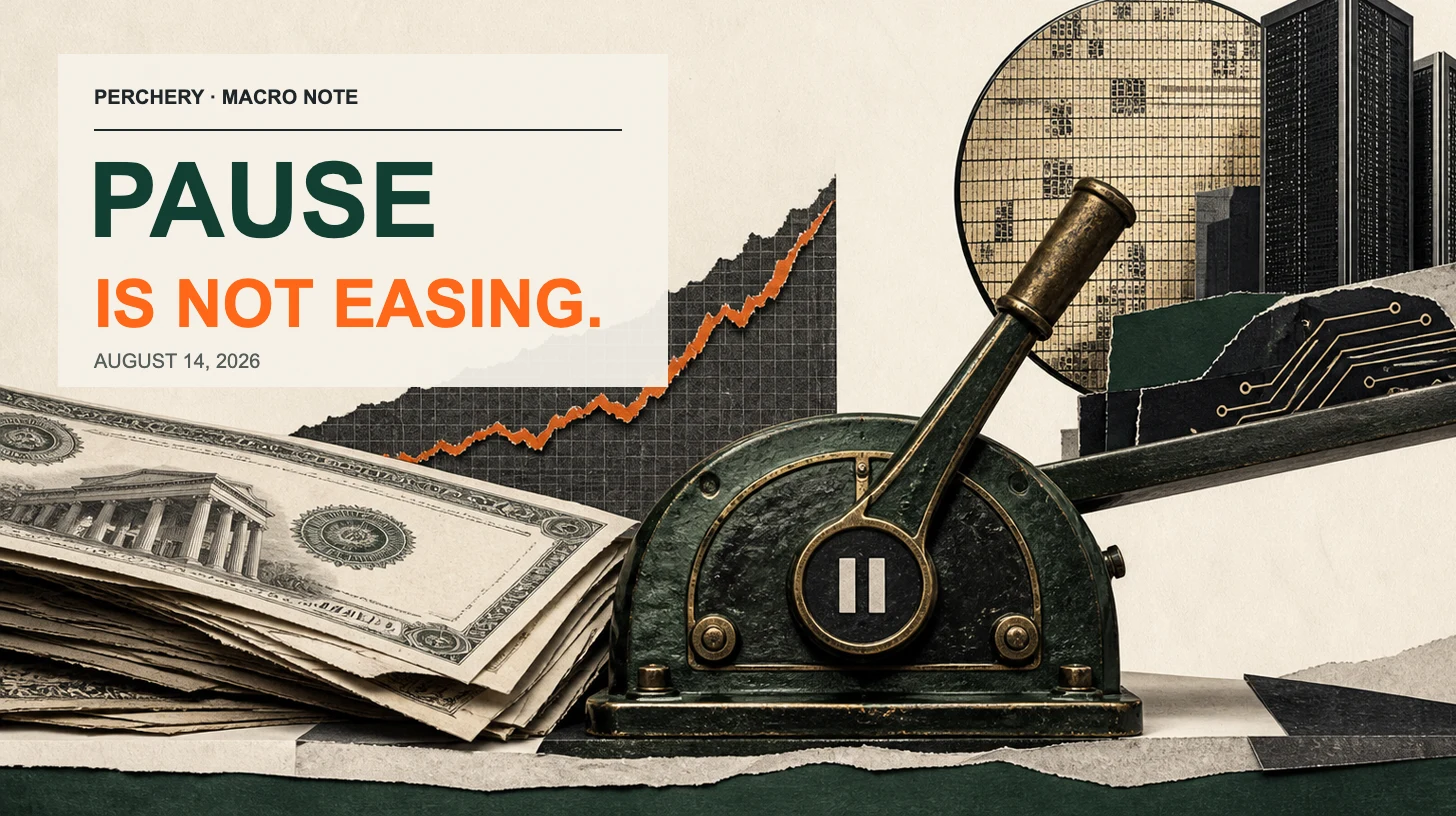
That is a meaningful change. It is not monetary easing.
The policy rate is still 3.50% to 3.75%. The Fed's June projections put 2026 PCE inflation around 3.6%, nowhere near a clean victory over inflation. Oil is pushing the wrong way. Financial conditions are hardly restrictive when speculative AI stocks can still rip while the semiconductor index itself is down.
The market has moved from "the Fed may hike" to "great, maybe the Fed will not hike." Fair enough. But there is no law saying the next step must be a cut.
Those are my judgment calls, not outputs from a sacred spreadsheet. The point is simpler than the percentages: the highest-probability outcome is still restrictive policy sitting in place, not a new easing cycle.
That makes the August 27-29 Jackson Hole symposium more interesting than usual. If Fed officials say current rates are restrictive enough and inflation is moving in the right direction, the pause trade can keep breathing. If they focus on 3% inflation, loose financial conditions and energy risk, the market may discover it celebrated the press release before reading it.
Subjective policy board
- A hold: 60% to 65%
- At least one more hike: 25% to 30%
- A genuine turn toward cuts: 10% to 15%

The Bond Market Is Not Clapping
The long end is the part I find hardest to square with the equity party.
The 10-year yield is roughly 4.7%. The 30-year is around 5.2%. Thursday's $25 billion 30-year auction cleared at 5.216%, the highest auction yield since 2001. The 30-year real yield has been hovering near 3%, around its highest level since 2008.
Weak retail sales should have made the basic trade easy: softer economy, friendlier Fed, higher bond prices, lower yields. Yields did initially fall. Then the long end pushed back up.
That price action suggests the bond market is trading more than the next Fed meeting. It is looking at persistent deficits, heavy Treasury supply, energy-driven inflation risk and a rising term premium. It also has to absorb an extraordinary private-sector demand for capital as hyperscalers fund the AI buildout.
There is no need to turn this into an apocalypse story. Buyers still showed up for the auction. They just demanded a very expensive price from the borrower.
For equity valuation, that distinction does not help much. A real risk-free yield near 3% is a serious competitor to long-duration cash flows. If investors can earn that without underwriting AI market share, data-center utilization or heroic terminal margins, then expensive AI infrastructure and semiconductor stocks have to keep delivering exceptional growth merely to defend the multiples already on the screen.
The bond market has been sending that message for a while. Equities have decided it can wait in the lobby.
Maybe they are right for another month. They are not exempt forever.

Calm on the Surface, Nerves Underneath
The volatility market makes the setup stranger.
VIX remains in the mid-teens, close to the low end of its 2026 range. On the surface, investors are not paying much for ordinary near-term volatility. At the same time, Cboe has described downside skew as extremely elevated, meaning protection against ugly tail outcomes is getting relatively expensive.
Low VIX plus rising SKEW is not a crash timer. Anyone selling it that way is doing astrology with better fonts.
It does say the average day looks calm while some investors are quietly paying up for the bad ending. That fits the rest of the picture: record-adjacent indices, expensive AI momentum, weak consumer data, 5% long bonds and an oil market that can still inject fresh inflation into the story.
The market is relaxed. It is not completely relaxed.

SOXX Is the Cleaner Stress Gauge
SOXX slipping about 1% on a day when parts of the AI complex were still surging is more useful to me than another victory lap around whichever ticker happens to be hottest.
The divergence says two things at once. Semiconductor breadth is not uniformly healthy, but stock-specific momentum remains powerful enough to ignore it. That can happen when investors are crowding into the handful of AI stories with the cleanest earnings surprise, the loudest capacity narrative or the freshest analyst upgrades.
I do not read that as proof the AI trade is finished. I read it as a less forgiving phase of the trade.
When the whole semiconductor complex rises together, the macro story has some participation behind it. When SOXX weakens while the highest-beta AI stocks keep launching, the burden shifts toward momentum, positioning and squeeze mechanics. The rally can continue, but fewer names are carrying more narrative weight.
That distinction matters because a squeeze is not a fundamental rebuttal. High-beta AI stocks do not need a new breakthrough every morning to keep rising. Short covering, options positioning and trend-following flows can push them well beyond any tidy valuation argument. A skeptical macro view can be directionally right and still get steamrolled by the route prices take.
So I am not calling the exact top in AI. I am watching whether SOXX can regain strength while long yields remain elevated. If semiconductor breadth improves, real yields roll over and breakouts start holding across the group, the market will have earned more of its optimism. If SOXX keeps losing ground while a shrinking group of AI winners does all the work, I will treat that as topping behaviour, not healthy leadership.
What would make me less skeptical? Long real yields falling for a durable reason. Inflation cooling enough to make cuts plausible rather than merely making a hike less likely. Oil stabilizing. Better market breadth. And AI strength spreading through the semiconductor complex instead of concentrating in a few momentum vehicles.
Until then, my view is unfashionable but fairly simple: the market has priced a pause like the opening move of an easing cycle. The bond market has not confirmed that story, and the volatility surface is not as carefree as the index suggests.
I would rather wait for topping evidence than pretend I know the exact tick. I would also rather miss the first part of a reversal than discover that being right about the destination does not stop a squeeze from running me over on the way there.
The macro case and the path are two different problems. Right now, the macro case is getting more bearish. The path is still wearing a rocket costume.
Source and Publication Note
This Free edition mirrors the Perchery article published on Substack on August 14, 2026. The original Perchery content ID, publication date, and public distribution URLs are preserved in the shared editorial record.
The article uses public-source macro and market information. The policy probabilities are subjective research judgments rather than model outputs, and the distinction between the macro case and the path of market prices remains central to the analysis.