
A Partial, Not a Victory Lap
The August 27-September 1 forecast has not earned a victory lap. It has earned a provisional partial. The timing and market-internals portions are working; the broad bearish direction is not confirmed.
SPY and QQQ remained above their August 26 closes through Friday, volatility stayed calm, and the indexes did not break. The less comfortable evidence sat underneath them: semiconductor breadth failed after NVIDIA's surge, crypto proxies round-tripped, gold was hit by a real-yield shock, and short-rate expectations repriced sharply after Chairman Kevin Warsh spoke.
The base path remains frozen. Unstable two-way movement through September 1 is still plausible. A repair attempt during September 2-8 remains possible if credit and volatility stay contained. The stronger test remains September 9-16. Those dates do not move because the first two sessions were noisy.

The Provisional Score
A useful forecast record distinguishes a directional miss from a timing observation. It also refuses to turn every noisy move into a success.
| Forecast component | Provisional status | Evidence through August 28 |
|---|---|---|
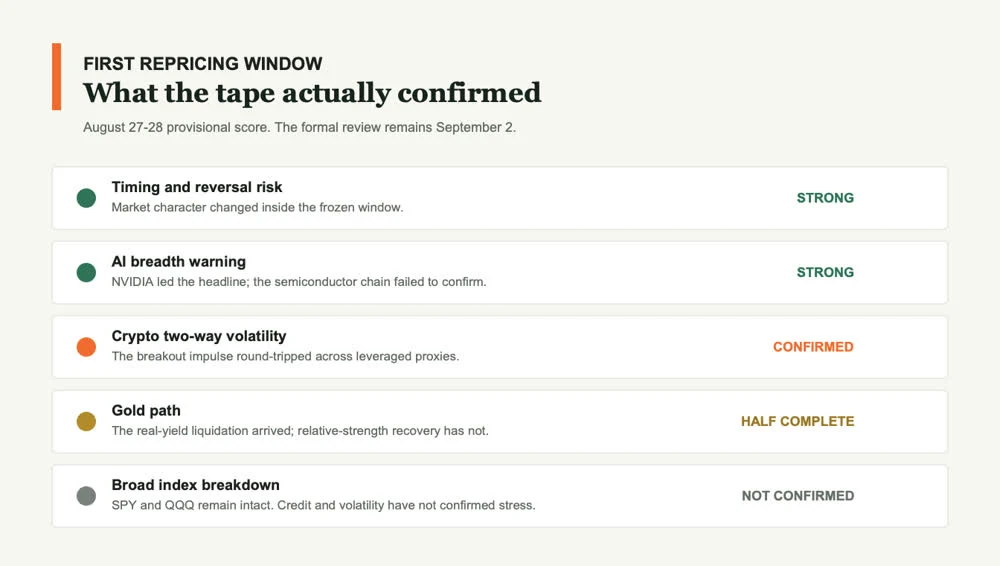
| Timing and reversal risk | Strong | Market character changed inside the frozen observation window. |
| Broad-equity direction | Not confirmed | From the August 26 close through Friday, SPY gained about 0.43% and QQQ about 0.71%. |
| AI breadth warning | Strong | XLK gained about 1.56% across Thursday and Friday while SOXX lost about 1.32% and DRAM about 0.99%. |
| Crypto two-way volatility | Strong | Bitcoin rose about 1.58% on Thursday and fell about 3.03% on Friday; Solana rose about 6.94%, then gave back about 4.61%. |
| Gold relative-strength path | Half complete | The liquidity-driven decline arrived. Stabilization and relative recovery have not. |
Evidence worth keeping in view
The main observations remain separate so one strong item cannot silently stand in for the whole case.
Timing and reversal risk
CounterevidenceStrong
Market character changed inside the frozen observation window.
Broad-equity direction
MechanismNot confirmed
From the August 26 close through Friday, SPY gained about 0.43% and QQQ about 0.71%.
AI breadth warning
InferenceStrong
XLK gained about 1.56% across Thursday and Friday while SOXX lost about 1.32% and DRAM about 0.99%.
Crypto two-way volatility
InferenceStrong
Bitcoin rose about 1.58% on Thursday and fell about 3.03% on Friday; Solana rose about 6.94%, then gave back about 4.61%.
Gold relative-strength path
HypothesisHalf complete
The liquidity-driven decline arrived. Stabilization and relative recovery have not.
Thursday Looked Better Than It Was
August 27 was built to look bullish. NVIDIA gained about 8.74%, QQQ rose about 1.37%, and XLK climbed about 3.16%. Stopping at those three numbers would make the AI complex look healthy again.
The wider chain disagreed. AMD fell about 0.89%, Micron slipped about 0.32%, Marvell declined about 1.49%, and SanDisk fell about 0.96%. NVIDIA carried the headline while too much of the infrastructure chain stood still or moved backward.
Friday made the split harder to ignore. NVIDIA fell about 4.58%, SOXX lost about 3.20%, AMD declined about 2.33%, and Marvell fell about 10.29%. Broadcom held up better, but the group did not deliver the broad confirmation required to overturn the cautious path.
Leverage and Gold Exposed Different Weak Points
Crypto-linked equities delivered the clearest two-way stress. MSTR moved from an 11.54% gain on Thursday to a 7.34% decline on Friday. BMNR moved from +2.89% to -7.14%, and FWDI from +12.31% to -11.56%. That is not a stable expansion. It is leverage revealing how quickly the same mechanism works in reverse.
Gold did not behave like a completed safe-haven path. GLD fell about 3.24% on Friday and UGL about 6.58% as rate expectations shifted. The original forecast allowed for gold to be liquidated first during a cash or real-yield shock. The constructive half of the path now requires GLD to stabilize and begin outperforming higher-beta assets.
Only the first half has occurred. Treating the decline itself as full confirmation would erase the most important part of the forecast: the expected relative recovery.
What Changed in the Policy Contract
The simplest reading of Chairman Warsh's August 28 Jackson Hole speech is that it was hawkish. The deeper change was institutional. He argued that routine forward guidance has overstayed its welcome and that the central bank should not encourage markets to look primarily to the Fed for their next move.
His economic assessment left little room for an automatic rescue narrative. AI investment is running quickly, S&P 500 profits have grown more than 20% over the past year, credit spreads are tight, loan conditions are easy, labor is near full employment, and broad financial conditions are difficult to describe as restrictive. Against that backdrop, he cited twelve-month PCE inflation of 3.7% and a six-month rate of 4.1%.
The decisive sentence rejected a comfortable assumption: price stability is not self-executing, and inflation is not necessarily mean-reverting. Markets can still advance under that framework, but they should not expect a neat policy roadmap or a scheduled rescue. Policy optionality has become part of the tool.
A Treasury-Fed Division of Labor Is an Inference
The following interpretation is an inference, not evidence of a formal agreement. Treasury is supporting long-end market functioning while also applying pressure to oil and financial channels connected with Iran. The Fed is preserving the credibility of short-rate restraint so that an energy shock does not become a persistent inflation regime.
Those efforts can complement one another if oil normalizes, long yields stop climbing, and inflation expectations remain anchored. They can also conflict if crude stays high, inflation breadth refuses to improve, or long-maturity liquidity support fails to restrain the term premium.
In the failure case, Treasury support and central-bank restraint stop looking like coordinated layers. They begin to look like two institutions confronting the same inflation-and-funding problem from opposite sides.
The Next Observations Have to Agree
The cautious case becomes stronger if SPY and QQQ give back Thursday's advance, semiconductor weakness spreads beyond a few companies, VIX leaves the 14-15 area, high-yield spreads widen, and long yields or oil continue rising. Gold stabilizing while those conditions worsen would complete the relative-strength part of the original path.
The cautious case weakens if SOXX regains breadth, DRAM confirms rather than lags, credit remains calm, long yields stabilize, and the crypto complex holds Friday's damage without another leverage flush. That combination would fit a concentrated earnings reversal followed by repair rather than a wider autumn decline.
The first window did not deliver a clean index break. It delivered something more useful: a stress test that exposed concentrated leadership, rate sensitivity, and the speed of a policy-narrative change.
Formal review boundary
- The frozen forecast language and dates remain unchanged.
- The September 2 review will separate timing, direction, breadth, gold relative strength, and any invalidation that occurred first.
- No later observation will be used to rewrite what the original forecast said.
Sources and Method
This Free edition mirrors the Perchery article published on Substack on August 29, 2026. It follows the forecast frozen before the August 27-September 1 observation window. The original language, dates, confirmation conditions, invalidation conditions, and September 2 review date remain unchanged.
Policy interpretation is based on Chairman Warsh's August 28 Jackson Hole speech, Treasury's long-end liquidity-support announcement, and official Treasury releases describing its Iran-related financial measures. The proposed Treasury-Fed division of labor is analytical inference, not a claim of disclosed coordination.
Market returns use close-to-close public price data for August 27 and August 28. They describe the source article's observation window and can become stale quickly.